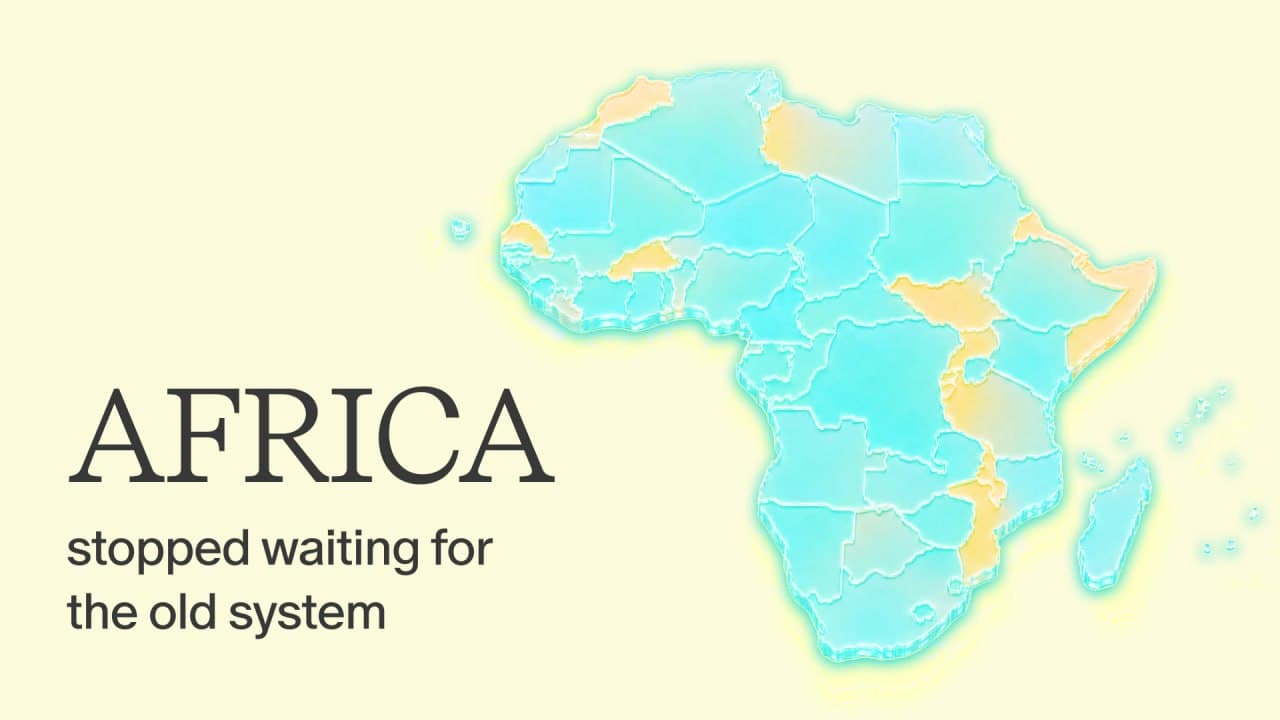
Last year, more than $205 billion in on-chain value moved through Sub-Saharan Africa. The figure comes from Chainalysis's 2025 Geography of Crypto report, and it puts the region third for growth in the world, behind only Asia-Pacific and Latin America. Up 52% in twelve months.
Now stand a person next to that number.
Most of the money moved in small increments. More than 8% of all value in the region moved in transfers under $10,000, against 6% everywhere else. Picture who moves a sum that size, a trader in Lagos paying a supplier in Nairobi, a daughter in Accra sending rent home, a shop owner keeping a dollar balance so a month of margin does not vanish the next time the local currency slips.
The month the naira broke, the money moved anyway
In March 2025, on-chain volume in the region climbed to nearly $25 billion in a single month. Every other region fell. Africa did not. Nigeria's currency had just devalued, and people moved their savings ahead of it. When your money loses value while you sleep, a stablecoin is not an investment. It is a tool for wealth preservation.
The same pattern repeats through the report. Bitcoin makes up 89% of crypto purchases in Nigeria and 74% in South Africa, well above the 51% you see in dollar markets. Where dollars are hard to come by and inflation is not, bitcoin became the savings account no bank was offering. Stablecoins are following it in. USDT already takes a growing share of Nigerian purchases, doing the one job the official exchange rate will not: holding its value.
The old pipe still takes its cut
Nigeria alone saw more than $92.1 billion in digital-asset inflows last year, close to three times the next country. Ethiopia, Kenya, and Ghana round out the top five. You can read that as a story about onchain adoption. I read it as a verdict on the system people are trying to work around.
The plumbing of global money has barely moved in fifty years. SWIFT dates to 1973. A cross-border payment still costs 6.36% on average, and still takes one to three days to clear through correspondent banks. Every year, $685 billion crosses into low and middle income countries down that same slow, expensive pipe.
People are not moving into these rails because they suddenly become speculators. They are moving because the old rail failed them first.
This is the market we build for
We do not build Movement as charity. We build it because the commercial case is plain: hundreds of billions of dollars in motion, on rails that punish the people using them.
We settle stablecoins in under a second, where the old system takes three days. We give the fintechs and neobanks serving these corridors a way to earn on the stablecoin capital they already hold, instead of letting it sit idle. We connect them to licensed payment rails through partners in the US, Canada, and the EU, so they grow inside the rules rather than around them. And the customer never hands over custody of their own money to do any of it.
There is a quiet line near the end of the report. Its numbers only count centralized exchanges. The B2B flows, the OTC trades, the multi-million dollar stablecoin transfers moving energy and merchant payments between Africa, the Middle East, and Asia. None of it shows up. So the true figure runs well past $205 billion, and that off-screen flow, the settlement layer sitting under the trade, is where we work.
We are not in the business of ivory tower pontification. We get on the flight and shake the hands. We find the factory owner, the payments company, the bank that was told to wait its turn, and we put in place the rail no one thought was worth building. The people in these markets are underserved, but not forgotten.
- Torab
Figures cited are from Chainalysis, 2025 Geography of Crypto Report. Movement provides stablecoin settlement infrastructure and opt-in yield vaults for emerging market corridors. Access to licensed payment rails is provided through Movement's partner network; Movement does not hold these licences directly.